Aga Khan Development
Network (AKDN) is one of the world's leading poverty solutions
networks. AKDN works together with communities to help them around the world to
build better futures. Each year the AKDN helps improve the quality of
life for tens of millions of people in over 30 countries. AKDN works in countries where life is
hard, poverty is dire, and more help is needed.
AKDN is different from other
poverty alleviation organizations in the world.
AKDN says
"We don't just provide services or
goods. We dedicate ourselves to partnering with communities to improve their
quality of life for decades and generations. We make long term investments,
from early childhood programs to universities that benefit 2 million students
every year. We build hospitals and schools to make sure everyone has access to
world-class institutions. We work with people to serve their community and build
their local economy. Our work impacts tens of millions in over 30 countries
every year."
"In AKDN's experience,
the understandable but short-term humanitarian impulse to help poor people is
usually not enough to lift them out of the cycle of poverty. For AKDN, poverty
alleviation is conceived as part of a long-term strategy for developing a community's
resources in ways that lead to self-reliance."
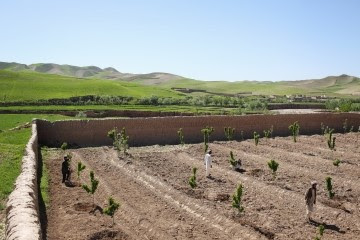
A cherry and apple orchard Demonstration
Plot planted with the assistance of the Aga Khan Foundation, in Rustaq
District, Takhar, Afghanistan.
In Cabo Delgado, Mozambique, the
Aga Khan Foundation launched the Enhancing Food Security and Incomes (FSI)
initiative to improve agricultural production and market linkages for
smallholder producers, sustain access to basic financial services, facilitate
non-farm enterprise, and enhance nutrition-related awareness and practices.
Hidden hunger-
In
an Aga Khan University's Conference on Nutrition and Early Human Development,
speakers talked about Hidden hunger in Pakistan. They said that Hidden Hunger
is present among half of the Pakistani Children. A lack of iron, vitamin A or
vitamin D is often referred to as 'hidden hunger.' Its symptoms are not visible
as in other forms of malnutrition, such as wasting and being underweight. But a
lack of these essential micronutrients can lead to serious, lifelong
repercussions, including delayed growth, reduced immunity to disease, frequent
fatigue, and low school achievement.
Crossing the Pyanj river:
Delivering milk to Afghan schools.
This is a story of great planning,
courage, and endeavor.
Watch yourself.
AKDN has given me
great insight into Poverty. I now realize that providing food to the hungry is
not a lasting solution. We need to bring social change, and these social
changes take years to give its fruits.
In September 2015,
the UN adopted a plan for achieving a better future for all – laying out a path
over the next 15 years to end extreme Poverty, fight inequality and injustice
and protect our planet.
Let's hope and put
our part to the UN's plan of ending extreme Poverty by 2030.
I am a member of the National
Association for the Education of Young Children (NAEYC). I have all appreciation for this organization. It works
to promote high-quality learning for all children from birth to age 8. It
connects early childhood practice, policy, and research. NAEYC has nearly
60,000 members of the Early Childhood Community and 52 affiliates.
The collective vision of
NAEYC is:
Learn more about NAEYC through this video:
NAEYC publishes many
magazines and journals every month. I like the magazine Teaching Young Children
(TYC).
This magazine is of great benefit to professionals working
with preschoolers. It is a colorful, informative, and easy-to-read magazine.
This
current issue of October/November 2020 features articles on partnering with
families, helping children through change, supporting anxious children in the
preschool classroom, and more.
The website of the organization is full of
resources related to the topic of the week:
Changing Demographics and Diversity
Hereunder I am providing the names of articles
and their links.
Podcasts on Early Childhood has a wealth of information.
Since it is transmitted through voice, it also depicts the emotion of the author. I
spent several hours diving into this sea of information. This is a vast sea; I
have just touched its shore.
This
week, I have selected the following podcasts from Save the Children Website.
How children globally faced COVID-19.
Here is an introduction
to the topic from the website.
All over
the world, the pandemic has turned children's lives upside down. In this
episode of Save the Children documentary,
they share their stories. Follow along to northern Colombia, where nothing is
the same in 15-year-old Mary's life, and on to the war in Afghanistan where
vaccinations stopped, and food shortages threaten. Hear 16-year-old Vusi in
South Africa about how the strict lockdown made an already challenging
situation impossible and how a young rapper in Delhi's slum raises hope with
his songs.
I will not come in between you and the podcasts. Listen to
the podcast.
Expanding Resources
I have selected the Global
organization 'GlobalFund for Children (GFC)' and its website for study. The concept of GFC was born in 1990 when
Maya Ajmera saw some street children studying at the railway platform of Bhubaneswar in India. A local
organization was providing books and food to these children.
With the
concept of helping the local organization for the welfare of children, Maya Ajmera
founded GFC in 1994. It is a nonprofit
organization based in Washington, DC. The mission of the GFC is to transform
the lives of the world's most helpless children. So far, it has
invested more than $46 million among 729 community-based organizations and served
more than 11 million children and youth worldwide.
I like this website because it serves children globally.
There are several videos and articles ar this website that is informative and exciting.
As I reflect on what the term
"support" means to me, support means encouraging someone or helping
him/her succeed. I firmly believe that we can make a difference in the world with little support, encouragement, and guidance.
My Parents:
My parents were always my motivational force;
they always supported me and taught me to differentiate right from wrong. My parents ever
desired my sibling and me to be the best; they have played a significant role
in shaping my life.
In the photo, the girl sitting in the middle
is me.
And look, this is me now. Throughout this
journey in life, my parents inspired me. They made me a confident
individual who would have been lost without them.
My Husband:
A supportive husband is an absolute requirement for professional women.
He is something she looks for, and when she finds
him, she marries him.
(Alice.S Rossi)
My husband is my world. He is always there
when I need him. He guides me, encourages me, motivates me, and inspires me. He
always says, 'pursue your dream, no matter what happens.'
To get my Master's degree in Early childhood
is my dream, as well as my passion.
Challenge:
Life is full of challenges. I must say that I
am lucky that I am blessed with good people who motivate me not to give up and
encourage me to achieve my goal. I always think big, positive, and sound. I set
short term goals to achieve long term goals. As my mother always says to
us, "never complain about the challenges, they are there to polish you,
and one day you will overcome them."
Religion:
Religion is my strength. I believe that God does not burden anyone with a
load, which is more than his/her capacity. God is too generous to burden people with what they cannot
bear. So, I will meet all challenges with the support of God.
My support system gets me through the day or the week, or even
the year. They keep me going, and they're an essential part of my life.
Everyone needs that; I am lucky that I have my supports.
I was born and raised in Pakistan. When
I was young, I did not have any fancy gadgets or expensive toys.
I loved nature, and my parents were my big
supporter and teachers. When I used to go for a long walk with my
parents, I asked many questions? Like how and why season changes? Why
clouds move, and how are they formed? Why are stars seen at night and not at
noon? How plants grow. My parents used to explain and answer my question thoroughly.
When I was young, my mother used to ask me to
make bracelets of flowers; she used to give flowers and asked me if I could
count flowers. I used to get busy in counting flowers and making bracelets.
I was also a tomboy, used to play in the streets
in front of my house. Boys used to be my play partners.
The above photograph is showing me in my
childhood. Do you see the sparks in my eyes?
One of my favorite plays was Kancha. Kancha is
played with marbles.
Another play which I liked most is below.
At school, I loved playing tag, hide and seek,
and especially cricket.
Time has changed. Electronic gadgets have taken the place of
physical play. I do not see the children in the fields and parks now in the
evening. They sit around the TV and watch games.
Our childhood has moved indoors. Our children spend half the
time outdoor in play what they used to do two decades back. A Kaiser Family Foundation
research shows that children are spending seven hours daily on electronic
gadgets. This excessive play with electronic devices is taking a toll in the shape
of child obesity and lack of creativity. Even Steve Jobs, former Apple chief executive officer, was
worried at this exposure of children to gadgets.
I am sorry to admit that play has gone out of my busy life.
I am no more physically active. When I
look back to my childhood days, they were the golden days of my life. I miss
those golden days of play.
My mother is my
mentor, my friend, my coach, and whatnot. She inspired me for this Master of Science in Early Childhood Studies. She lives eight thousand miles away from me in
Pakistan. She talks to me daily. All my tension, mental agony, and anxiety go
away when I talk to her.
My immediate family
This is my immediate family. I may rely on them for any matter. The boy in the front is my grandson- a highschooler. You will find me just behind my grandson. Sitting by my side is my husband. On the right side, you will find my daughter-in-law, my son, and my granddaughter.
My kids
The children become very friendly with me. They love me, and I love them. But when they graduate in pre-k and leave me, I always miss them.
My friend, my sweetheart
She is Lora Anderson, my friend, my sweetheart. We lived together for a considerable time in Salina, Kansas. I could call her for any matter- as small as changing bulb in my garage or as big as relocation from Salina to Manhattan. She had been a telephone away, just inform her and she will be there for your help. When worried, call her; she is there to accompany you to Starbucks or Yougurtnee- our favorite entertainment points in Salina.
Libby Mychajliw
She was my Director at Early Learning Center in Maryland. She is
very organized, very loving, and very helpful. Go to her for any problem, and she will find a solution. She gave me the practical opportunity to learn about
Early Childhood.
I believe that Relationship solidifies with sincerity, unconditional love, and sacrifice.
But before that, we need to understand ourselves, and then we need to understand
others. We usually judge a person by their behaviors and not by motives. This
creates conflict. To have real Relationships, we need to go beyond behavior; we need to understand motives.
I think that our behavior is like this buoy. This can be seen by everyone. It is tilting, coming back, and then again tilting.
No one can see the anchor in the water to which this buoy is tied—our motives are like this anchor, which is not visible to anyone, which is not visible even to ourselves. Our Relationship will get strengthened if we could see behind the behavior.